





read
HomeAid Hawaiʻi: Building Deeply Affordable Housing
by






America’s housing crisis isn’t simply a question of how many homes we can build. It’s also a question of what they cost to build and who can afford them.
For households at the lowest income levels, often at or below 30% of area median income, even traditional affordable housing can remain out of reach. That is the gap deeply affordable housing is intended to fill.
At HomeAid Hawaiʻi, we have taken the construction model that has been part of HomeAid’s national network for decades and applied it to this gap in our local housing system. Over the past three years, we have built more than 750 homes while learning an important lesson: reaching the deepest levels of affordability requires changing the development equation.
The challenge isn’t simply finding more subsidies. It is reducing the cost of producing housing through approaches such as modular and prefabricated construction, shared infrastructure, simpler layouts and early builder involvement.
On one deeply affordable housing project, these partnerships and construction approaches reduced projected costs by 90% compared with traditional development estimates. Following the Maui wildfires, the building industry helped deliver one of the nation’s largest modular housing communities while generating $50 million in builder and philanthropic support and savings.
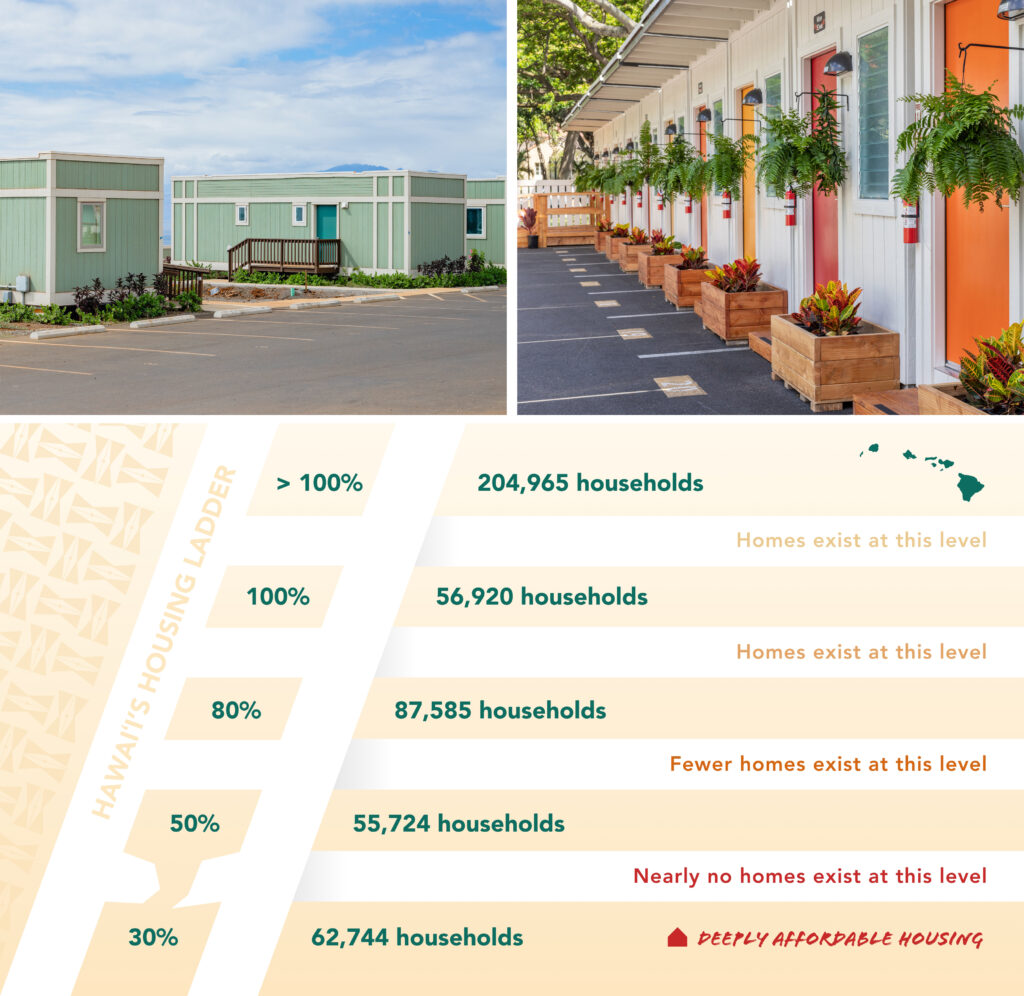
Kauhale, a local community-first housing solution tailored to housing those experiencing homelessness, has been one part of this work in Hawaiʻi, but it is not the only answer. Nationally, communities are using tiny-home villages, modular construction, adaptive reuse and other approaches to reach people conventional housing models have struggled to serve. The projects may look different, but the economics behind them are similar: If residents can afford only a few hundred dollars a month in rent, the cost of development must come down.
This is where HomeAid’s relationship with the building industry becomes especially valuable.
Founded by the residential construction industry, HomeAid America’s model is built around putting that industry’s expertise to work in communities. Today, its network of affiliates has completed over 1,700 housing and community projects, created more than 21,000 beds and served more than 1.8 million people experiencing or at risk of homelessness.
As one of those affiliates, HomeAid Hawaiʻi has adapted that proven model locally by serving as a nonprofit developer focused on deeply affordable housing. We bring builders, developers, trades, manufacturers and suppliers into projects early so their expertise can shape how housing is designed, sourced and delivered.
Don’t just keep up. Get ahead—with our biggest stories, handpicked for you each day.
That distinction matters. Builders contribute far more than donated labor and materials. They bring practical knowledge of constructability, purchasing, schedules and project delivery. Trade partners can simplify designs, manufacturers and suppliers can improve sourcing and logistics and developers understand land and infrastructure constraints.
That is what we are learning in Hawaiʻi: how the construction-industry model that HomeAid has used nationally for decades can be applied directly to deeply affordable housing development.
Making the economics work still requires other partners. Land, infrastructure and capital must come from somewhere and nonprofit operators and service providers have important roles to play. But if the goal is to reduce the actual cost of producing housing, builders need to be at the table from the beginning.
Now is the time to innovate. Construction costs remain high, land is limited in many markets, labor is scarce and long development timelines continue to push housing costs higher. At the same time, communities need more options for people whose incomes are beyond the reach of conventional development.
Deeply affordable housing will not replace traditional affordable housing, supportive housing or other parts of the housing continuum. It fills a gap those models have struggled to reach and no single building type or development approach will work everywhere. Kauhale, modular housing, adaptive reuse and other lower-cost models can each play a role.
What can be replicated is the way we approach the problem. In Hawaiʻi, more than 750 homes in three years have shown what can happen when the building industry is involved early. The same skills builders use every day to control costs and deliver housing are exactly the skills this work needs.
The question isn’t whether builders have a role in deeply affordable housing; we already know they do. The question is how we put more of that expertise to work, through HomeAid and beyond, to make deeply affordable housing possible in more communities across America.
By Kimo Carvalho. He is the Chief Executive Officer of HomeAid Hawaiʻi. To learn more or to get involved, please visit www.homeaidhawaii.org
This column is also featured in B&D September, read the print version.













Don’t just keep up. Get Ahead.
Sign up for our Newsletter to get the biggest stories, handpicked for you each day.