Market Research

Analysis and trends impacting construction, housing and development markets.

  • Market share of 5,000-square-feet homes inches higher

    Market share of 5,000-square-feet homes inches higher

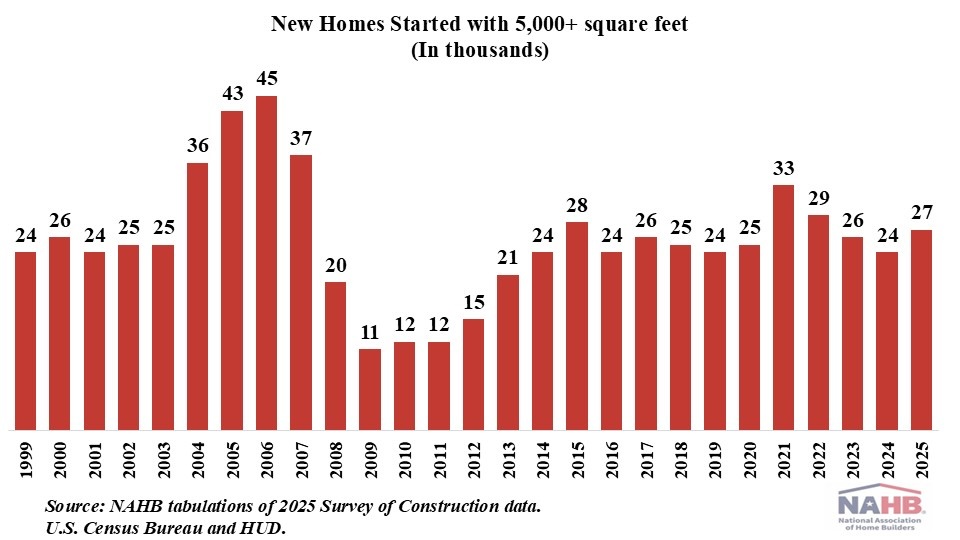
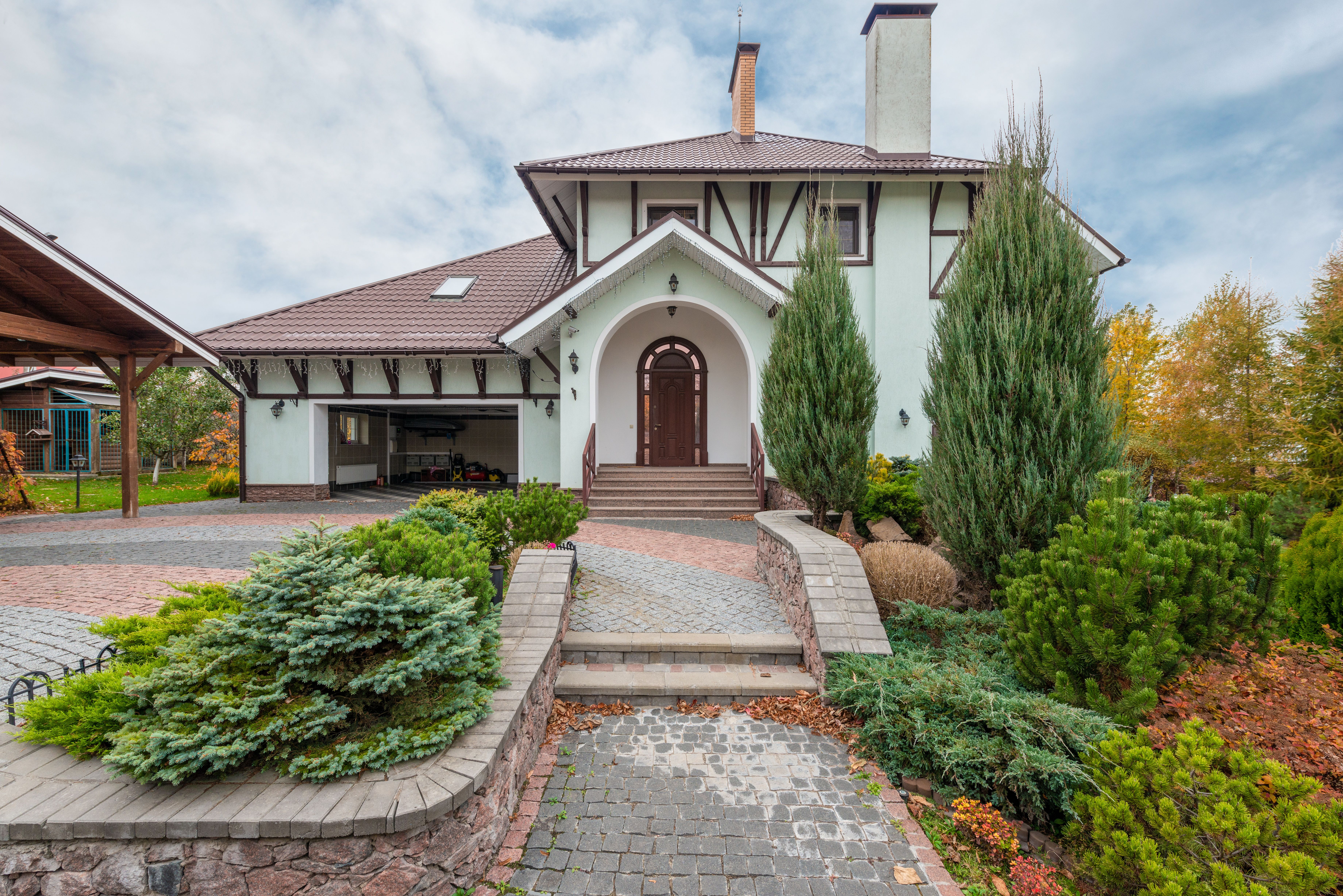
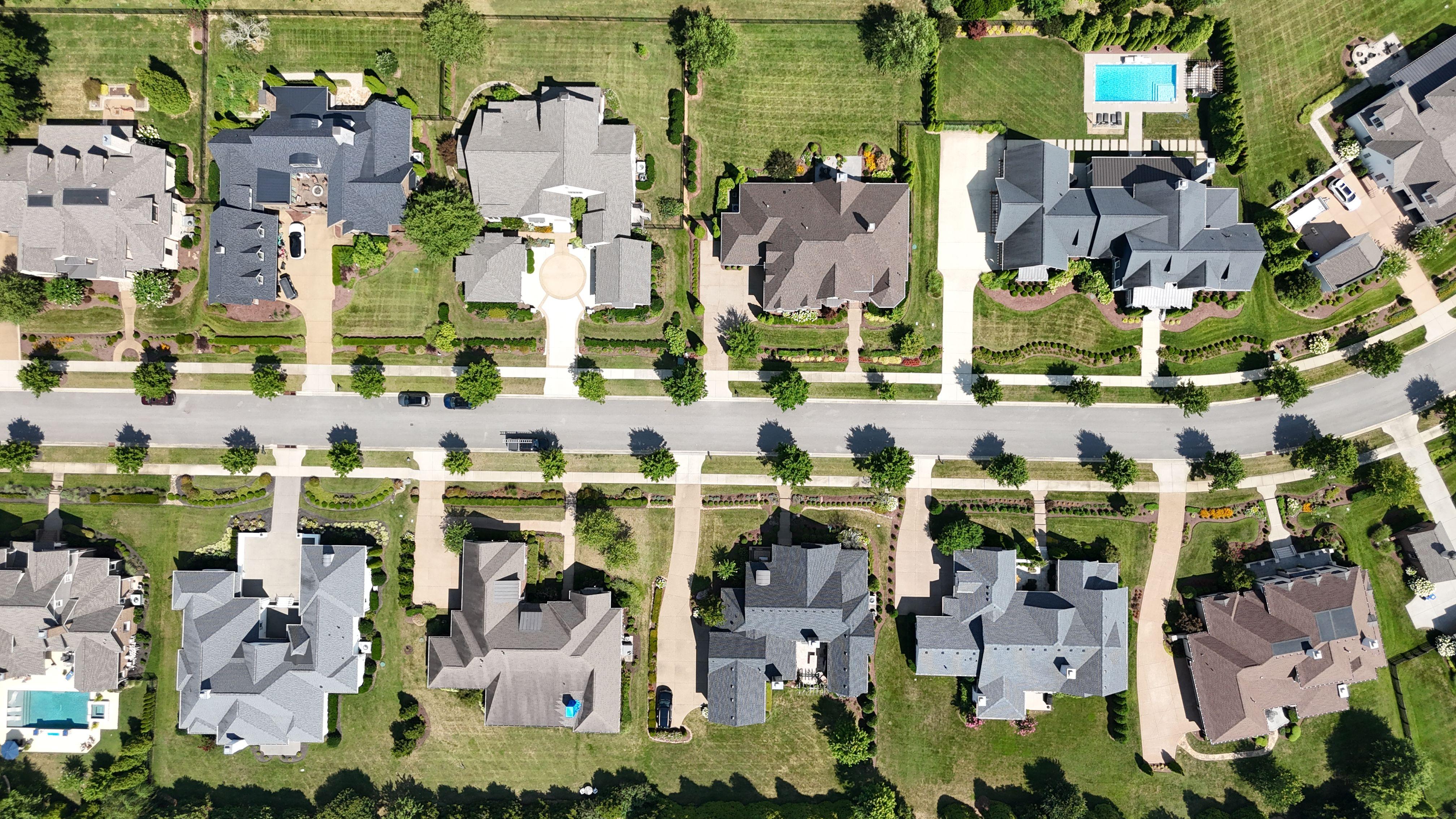
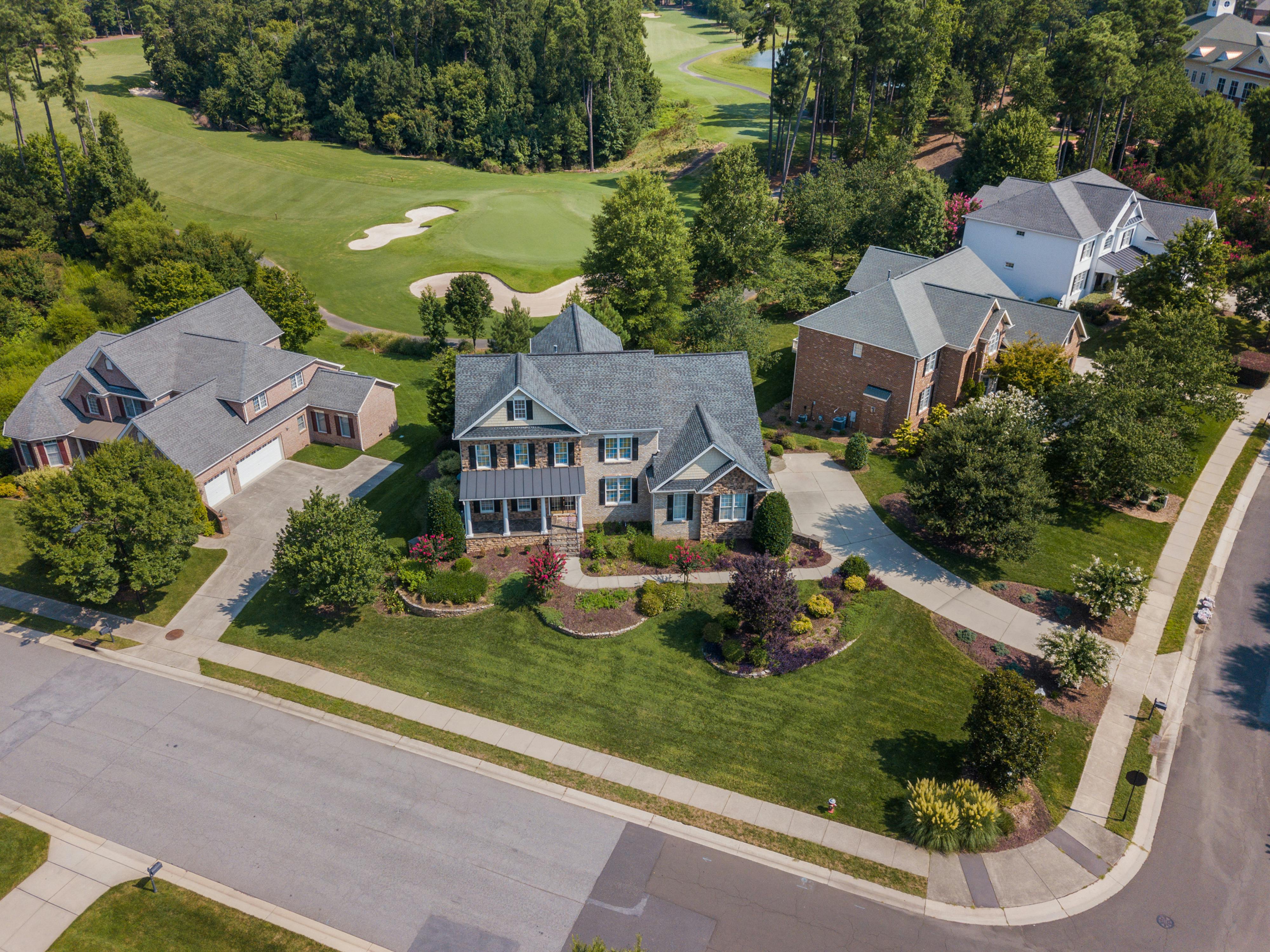
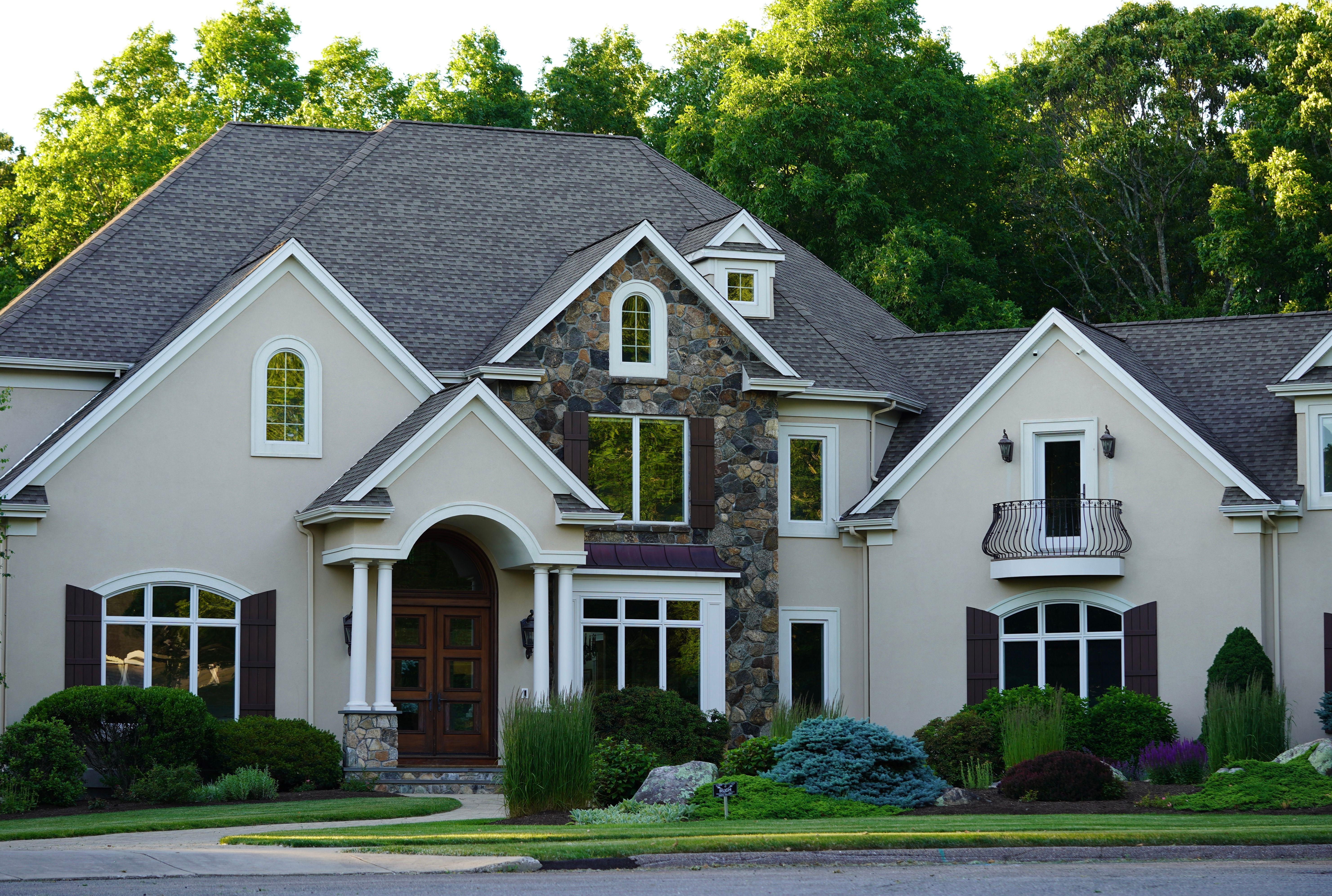
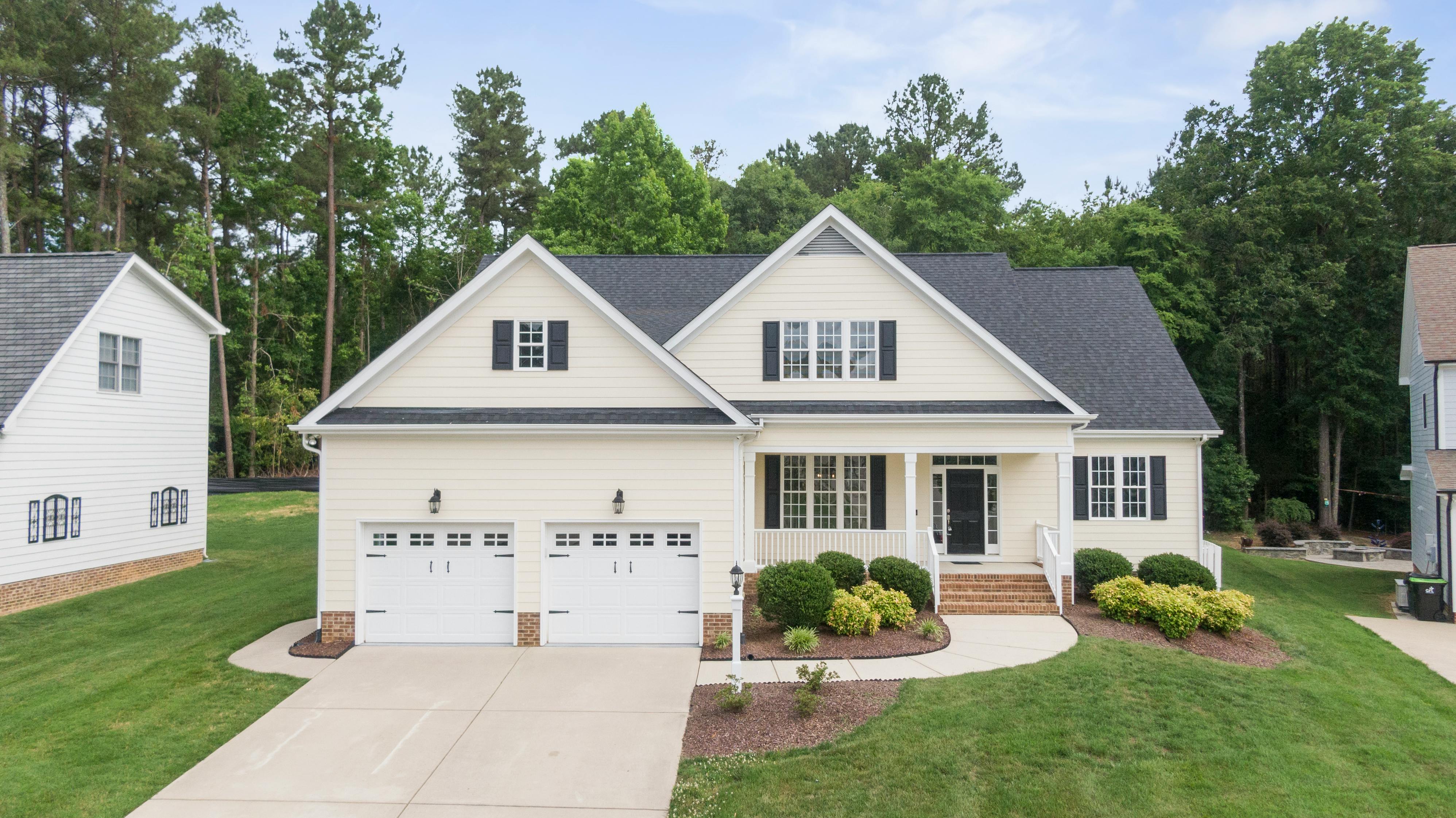
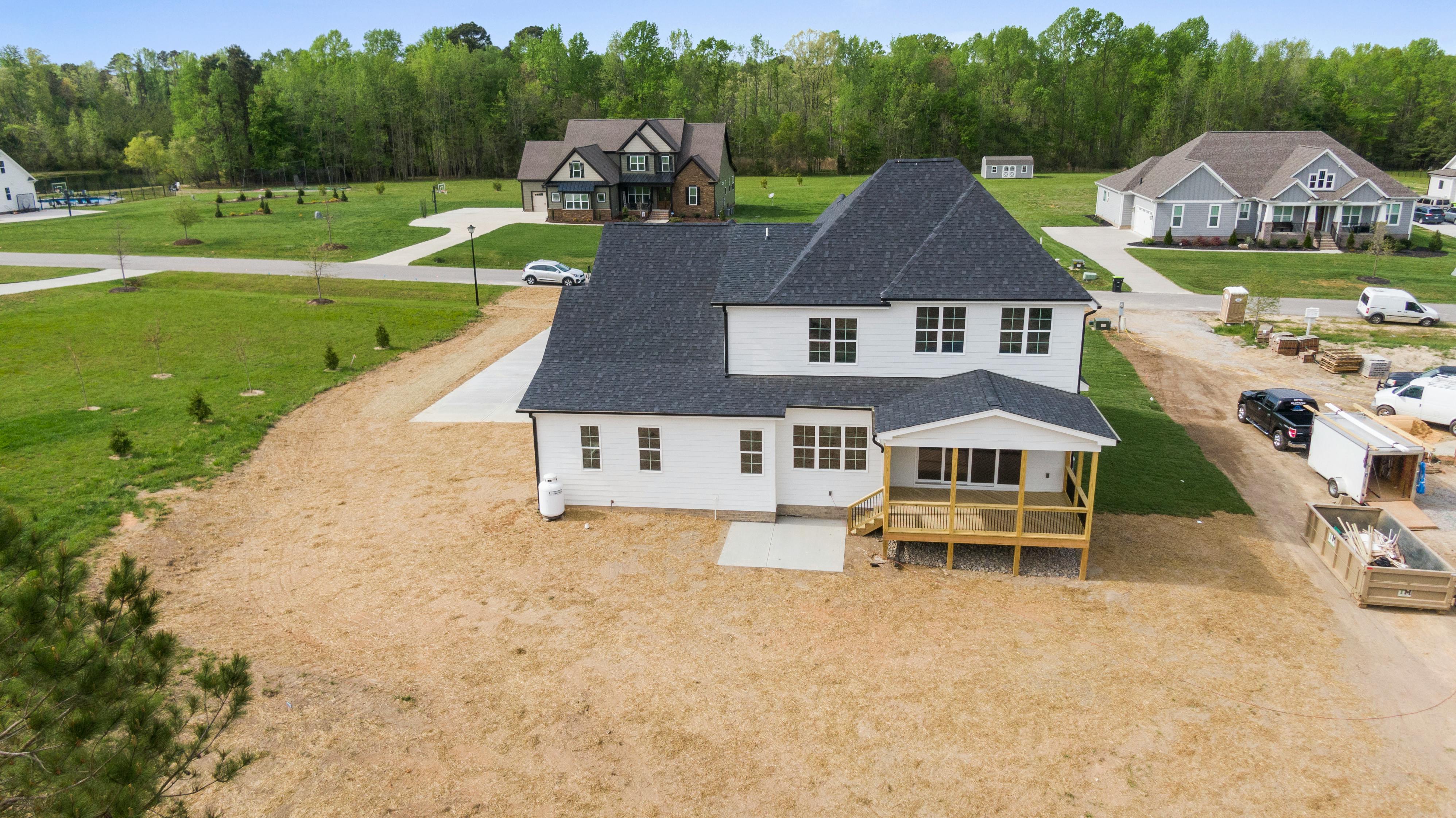
    The market share of homes 5,000 square feet or more accounted for 2.9% of all new home starts in 2025. According to annual data from the Census Bureau’s Survey of Construction (SOC), both the number and market share of homes with 5,000 square feet or more increased, from 24,000 homes in 2024 to 27,000 homes in 2025.

    In 2015, the 5,000-square-foot share reached a record high of 3.9%. Since then, it has fluctuated between 2.3% and 3.1%.

    Among homes of 5,000 square feet or more built in 2025, 86% have a porch, 73% have a finished basement, 73% have four or more bathrooms, 68% have a patio, 66% have a three-or-more-car garage, 57% have five or more bedrooms and 51% belong to a community association.

    Read Full Article

  • September builder confidence at 32

    September builder confidence at 32

    In the September National Association of Home Builders (NAHB) /Wells Fargo Housing Market Index (HMI), builder confidence fell three points from August to 32.

    This is the lowest recorded report since September 2025.

    NAHB Chief Economist Robert Dietz noted that this is likely a continuation of headwinds facing the homebuilding industry: building materials costs rising, elevated mortgage rates and labor concerns.

    With buyers more discerning, builders continue to offer incentives, up 3% from August. The HMI survey also reported that more builders cut prices than in August, but only by 1%.

    Regionally, the Midwest remains the strongest market despite dropping one point to 44. The Northeast saw the greatest decline, from 44 to 38. The South and the West remained fairly stagnant, with the South falling one point (31) and the West gaining one (28).

    With the Fed raising interest rates on Sept.16, 2026, builder buying power may also take a hit.

    “The HMI shows builder confidence at its lowest level since September 2025, as tight lending conditions and elevated land, labor and construction costs persist,” said Dietz. “Notably, 42% of builders rated current lot availability as poor and 38% as fair.”

    Read Full Article 

  • Mortgage rates average 6.76%

    Mortgage rates average 6.76%

    The 30-year fixed-rate mortgage (FRM) averaged 6.76%, according to Freddie Mac’s Primary Mortgage Market Survey (PMMS). Freddie Mac released the most recent PMMS results on Sept. 10, 2026.

    The current FRM is up from the previous week’s average of 6.71%. A year ago at this time, the 30-year FRM averaged 6.35%.

    The 15-year FRM averaged 6.09%, up from the week before when it averaged 6.04%. A year ago at this time, the 15-year FRM averaged 5.50%.

    “The 30-year fixed-rate mortgage averaged 6.76% this week,” said Sam Khater, Freddie Mac’s Chief Economist. “Aspiring buyers should remember shopping around for the best mortgage rate and getting multiple quotes can potentially save them thousands.”

    Read Full Article


  • Pace of new home sales softens

    Pace of new home sales softens

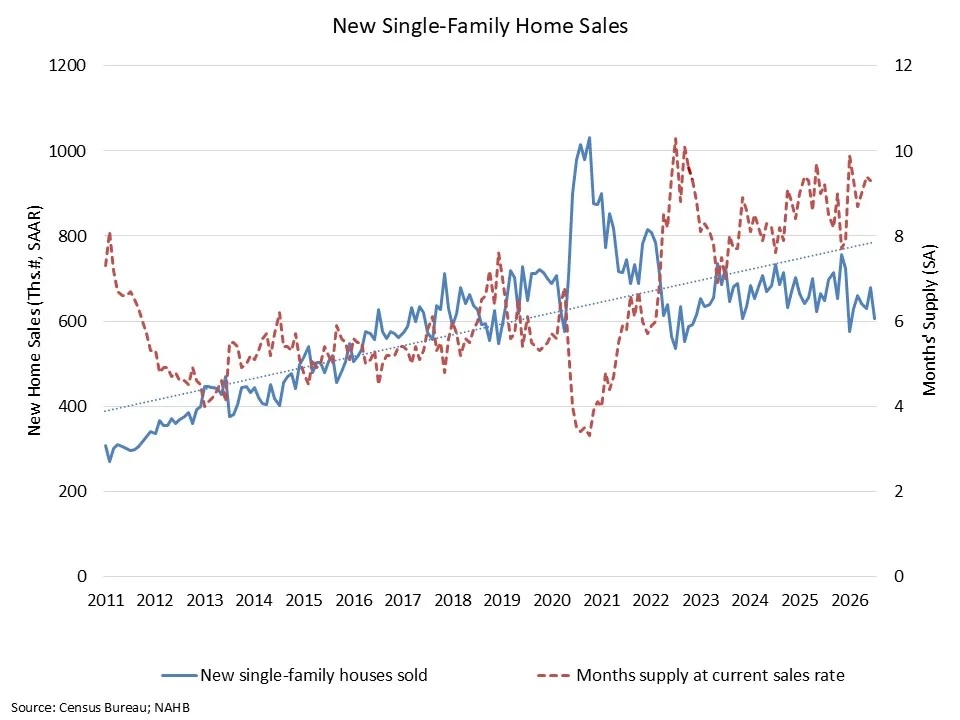
    According to newly released data from the U.S. Department of Housing and Urban Development and the U.S. Census Bureau, newly built single-family home sales declined 10.5% in July to a seasonally adjusted rate of 607,000, following an upward estimate of new home sales in June. New home sales were 6.3% lower than a year earlier, according to July data.

    A survey from the National Association of Home Builders shows that a majority of builders continue to offer incentives, including mortgage rate buy-downs, to accelerate the pace of new home sales. There is still hope in the industry as builders continue to outperform the broader market.

    Read Full Article

  • Mortgage rates average 6.67%

    Mortgage rates average 6.67%

    According to Freddie Mac’s Primary Mortgage Survey (PMS) released on Aug. 13, 2026, the 30-year fixed-rate mortgage (FRM) averaged 6.67%, a slight decrease from the previous week’s average of 6.69%.

    “Mortgage rates remained relatively stable this week at 6.67%,” said Sam Khater, Freddie Mac’s Chief Economist. “Housing affordability has improved from a year ago and recent increases in purchase and refinance applications suggest that borrowers continue to respond to even modest changes in mortgage rates.”

    A year ago at this time, the 30-year FRM averaged 6.58%.

    The 15-year FRM averaged 5.96%, down from the previous week when it averaged 6.01%. A year ago at this time, the 15-year FRM averaged 5.71%.

    Read Full Article

  • The importance of curb appeal in home purchases

    The importance of curb appeal in home purchases

    New data from John Burns Research and Consulting found that 34% of homeowners said that curb appeal played a significant role in home purchases. According to the New Homes Trends Institute, 15% said that lack of curb appeal was a deal-breaker.

    Most potential buyers will not make it past the front yard. From the 1,240 U.S. homeowners who were surveyed in June 2026, buyers said they expect quality landscaping from builders. The report emphasized that most buyers want a lush backyard just as much as they want a beautiful home.

    John Burns Research and Consulting’s monthly survey insights reports provide the latest findings on consumer behavior.

    Read Full Article

  • Builder confidence edges higher in August

    Builder confidence edges higher in August

    According to the National Association of Home Builders (NAHB)/Wells Fargo Housing Market Index (HMI) released on Aug. 17, 2026, builder confidence in the market for newly built single-family homes inched up one point to 35 in August.

    “While builder sentiment edged higher in August, builders continue to contend with high construction costs and broader economic uncertainty,” said NAHB Chairman Bill Owens, a home builder and remodeler from Worthington, Ohio. “However, the Midwest remains a bright spot for the home building industry, with new home sales up in that region more than 2% so far in 2026.”

    “Custom home builders continue to report stronger market conditions than spec builders, reflecting better conditions at the higher end of the market,” said NAHB Chief Economist Robert Dietz. “Smaller, less dense markets are also outperforming larger metropolitan areas, and smaller builders report relatively stronger conditions than larger builders.”

    Read Full Article

  • July building permits 5% above June estimate

    July building permits 5% above June estimate

    The United States Census Bureau released the Monthly New Residential Construction for July 2026. Privately owned housing units authorized by building permits in July were at a seasonally adjusted annual rate of 1,443,000, 5% above the revised June rate of 1,374,000 and 3.1% above the July 2025 rate of 1,400,000.

    Privately owned housing starts were at a seasonally adjusted annual rate of 1,239,000, 12.4% below the revised June estimate of 1,415,000 and 13.5% below the July 2025 rate of 1,432,000. Single-family housing starts in July were at a rate of 808,000.

    Privately owned housing completions were at a seasonally adjusted annual rate of 1,212,000, 9.1 percent% below the revised June estimate of 1,333,000 and 16.8% below the July 2025 rate of 1,456,000.

    Read Full Article

  • ‘Housing market is no longer moving in one direction’ says Cotality Chief Economist

    ‘Housing market is no longer moving in one direction’ says Cotality Chief Economist

    On Aug. 10, 2026, Cotality released its August 2026 U.S. home insights price report. According to the report, the Midwest and Northeast markets are still seeing firm price growth. Illinois is at a 6.4% year-over-year increase (YoY), followed by Connecticut at 6%, Nebraska at 5.8% and Indiana, also at 5.8%. National home price growth remains modest but shows signs of acceleration, edging up 0.3% month-over-month and 1.2% year-over-year in June 2026.

    “As long as mortgage rates stay consistently high, factors such as local job and income growth, migration patterns and specific industrial investments will influence the real estate market,” said Dr. Selma Hepp, Chief Economist at Cotality.

    Cotality also found that major industrial and tech investments are driving sharp local growth spikes-highlighted by Abilene, Texas, at +9.5% YoY, where AI data centers insulated the metro from broader statewide housing declines.

    “Cities like Abilene demonstrate that even in a cooling state like Texas, targeted capital projects can generate localized demand shocks that completely contradict regional trends,” said Hepp.

    Read Full Article


  • ‘Housing market is no longer moving in one direction’ says Cotality Chief Economist

    ‘Housing market is no longer moving in one direction’ says Cotality Chief Economist

    On Aug. 10, 2026, Cotality released its August 2026 U.S. home insights price report. According to the report, the Midwest and Northeast markets are still seeing firm price growth. Illinois is at a 6.4% year-over-year increase (YoY), followed by Connecticut at 6%, Nebraska at 5.8% and Indiana, also at 5.8%. National home price growth remains modest but shows signs of acceleration, edging up 0.3% month-over-month and 1.2% year-over-year in June 2026.

    “As long as mortgage rates stay consistently high, factors such as local job and income growth, migration patterns and specific industrial investments will influence the real estate market,” said Dr. Selma Hepp, Chief Economist at Cotality.

    Cotality also found that major industrial and tech investments are driving sharp local growth spikes-highlighted by Abilene, Texas, at +9.5% YoY, where AI data centers insulated the metro from broader statewide housing declines.

    “Cities like Abilene demonstrate that even in a cooling state like Texas, targeted capital projects can generate localized demand shocks that completely contradict regional trends,” said Hepp.

    Read Full Article

  • Mortgage rates average 6.69%

    Mortgage rates average 6.69%

    As of Aug. 6, 2026, mortgage rates averaged 6.69%, according to Freddie Mac’s Primary Mortgage Survey (PMS). These results are up from last week’s average of 6.66%. A year ago at this time, the 30-year FRM averaged 6.63%.

    “The 30-year fixed-rate mortgage averaged 6.69% this week,” said Sam Khater, Freddie Mac’s Chief Economist. “While mortgage rates continue to influence affordability, the housing market is showing signs of adjustment, with listing prices modestly below year-ago levels and for-sale inventory improving from the limited supply seen in recent years.”

    The 15-year FRM averaged 6.01%, down from the previous week’s 6.04%. A year ago at this time, the 15-year FRM averaged 5.75%.

    Read Full Article

  • Residential construction spending averages $877.1 billion in June

    Residential construction spending averages $877.1 billion in June

    On Aug. 3, 2026, the United States Census Bureau released its Monthly Construction Spending in June 2026 report. According to the report, residential construction was at a seasonally adjusted annual rate of $877.1 billion in June, 0.3% (±1.3%)* below the revised May estimate of $879.9 billion.

    Total construction spending during June 2026 was estimated at a seasonally adjusted annual rate of $2,166.5 billion, 0.1% (±0.8%)* below the revised May estimate of $2,168.5 billion. The June figure is 3.2% below the June 2025 estimate of $2,237.7 billion. During the first six months of this year, construction spending amounted to $1,046.9 billion, 3.5% below the $1,084.5 billion for the same period in 2025.

    Read Full Article

  • Mortgage rates average 6.66%

    Mortgage rates average 6.66%

    On July 30, 2026, Freddie Mac released the latest results of its Primary Mortgage Market Survey, showing the 30-year fixed-rate mortgage (FRM) averaged 6.66%. This was up from the week prior’s average of 6.58%. A year ago at this time, the 30-year FRM averaged 6.72%.

    “The 30-year fixed-rate mortgage averaged 6.66% this week,” said Sam Khater, Freddie Mac’s Chief Economist. “The housing market continues to benefit from more available inventory, providing prospective homebuyers with additional options and helping support buyer activity as mortgage rates fluctuate.”

    The 15-year FRM averaged 6.04%, up from the previous week when it averaged 5.96%. A year ago at this time, the 15-year FRM averaged 5.85%.

    Read Full Article

  • Mortgage rates average 6.58%

    Mortgage rates average 6.58%

    On July 23, 2026, Freddie Mac released the results of its Primary Mortgage Market Survey, revealing the 30-year fixed-rate mortgage (FRM) averaged 6.58%, up from the week before when it averaged 6.55%. A year ago at this time, the 30-year FRM averaged 6.74%.

    “The 30-year fixed-rate mortgage averaged 6.58% this week,” said Sam Khater, Freddie Mac’s Chief Economist. “As market conditions continue to evolve, borrowers should remember that shopping around for a mortgage rate can make a meaningful difference, potentially saving them thousands over the loan’s lifetime.”

    The 15-year FRM averaged 5.96%, up from the week before when it averaged 5.93%. A year ago at this time, the 15-year FRM averaged 5.87%.

    Read Full Article

  • Starter home prices outpace buyer income

    Starter home prices outpace buyer income

    The average age of a homeowner is 44, despite Gen Z homeownership rising in 2025. However, for buyers its not finding a home that is a challenge.

    According to recent research from Realtor, there are 300,000 fewer starter homes than before the pandemic. To address this, builders in 2026 are building on smaller lots at a quicker pace than the year before.

    The reality is the cost to purchase a starter home has dramatically increased. The average price of a starter home has risen from $256,000 in 2019 to $344,000 today. Consumer buying power and salaries have not followed suit. The average income needed to purchase is $78,000, up from $43,000 in 2019, while over the same period median household income rose only 28.3% at an estimated $69,000 to $88,100.

    “The barrier for today’s starter home buyer isn’t finding a home, it’s qualifying for one,” said Senior Economist “With mortgage rates still in the mid-6% range and the income needed to purchase a typical starter home up more than 80% since 2019, many would-be buyers are sitting on the sidelines even as listings accumulate.

    Read Full Article 


  • Mortgage rates average 6.43%

    Mortgage rates average 6.43%

    Freddie Mac released the results of its Primary Mortgage Market Survey on July 2, 2026, showing the 30-year fixed-rate mortgage (FRM) averaged 6.43%.

    “The 30-year fixed-rate mortgage eased slightly this week, averaging 6.43%,” said Sam Khater, Freddie Mac’s Chief Economist. “With rates at a seven-week low and purchase demand continuing to edge higher, it’s an encouraging sign as prospective homebuyers respond to modest improvements in affordability.”

    As of July 2, 2026, the FRM decreased from the week before, when it averaged 6.49%. A year ago at this time, the 30-year FRM averaged 6.67%. Meanwhile, the 15-year FRM averaged 5.79%, down from when it averaged 5.84%. A year ago at this time, the 15-year FRM averaged 5.80%.

    Read Full Article

  • Residential construction spending up 1.8% year-over-year

    Residential construction spending up 1.8% year-over-year

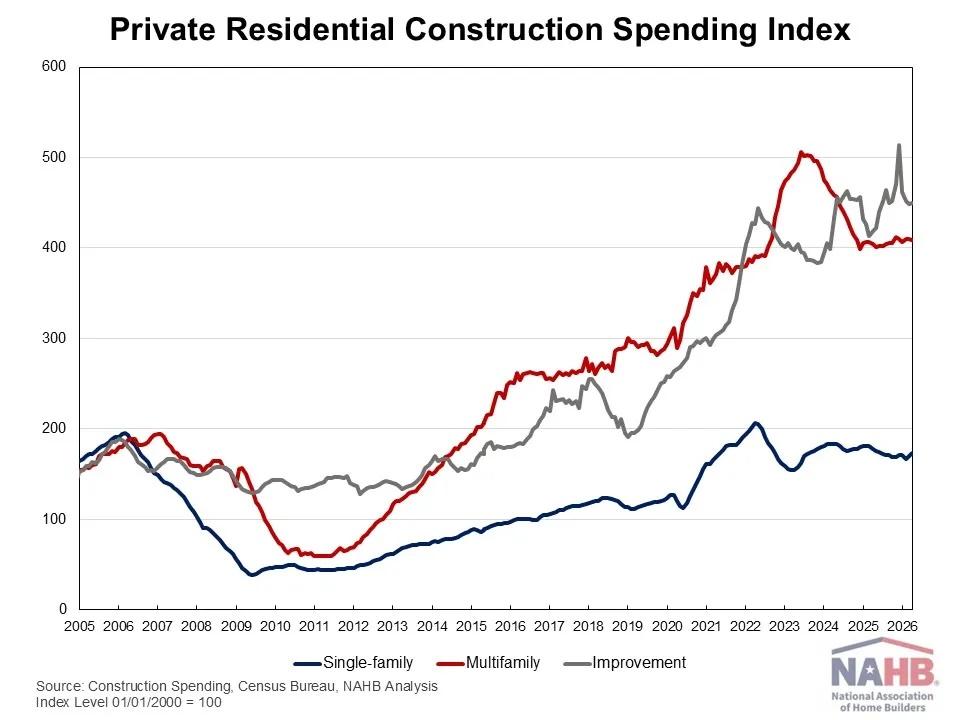
    According to the recently released May analysis from the U.S. Census Bureau, private residential construction spending continued its steady upward trend. Compared to a year ago, spending is up 1.8% and surpassed the previous month by 0.4.

    This is the third consecutive month of gains, following the slight dip in activity in February. The current pace is a moderate sign of a stabilizing market, despite consumer economic uncertainty and rise in material costs.

    Looking forward, the effects of the 21st Century ROAD to Housing Act is expected to streamline review for builders and diminish some of the costly boundaries for builders.

    “Multifamily construction spending growth has also slowed down after the peak in June 2023, with the index largely plateauing since late 2024,” said Catherine Koh an economist at the National Association of Homebuilders. “In contrast, improvement spending has been on an upward trend since the beginning of 2025, supported in part by the aging housing stock and sustained demand for renovation.

    Read Full Article 

  • Builders Can Successfully Transition Into Bathroom Remodeling

    Builders Can Successfully Transition Into Bathroom Remodeling

    Thinking about expanding your business into bathroom and shower remodeling? The biggest opportunities for builders exist within the wet space, especially remodels. Join Bestbath for a roundtable discussion on expanding into the wet space. Industry professionals will share perspectives on current market trends, business opportunities, operational considerations, and lessons learned from adding bathroom and shower projects to their offerings.

    Attendees will gain practical insights into what it takes to enter the category, common challenges to expect, and how other contractors have successfully incorporated wet space projects into their businesses.

    Learning Objectives:

    • What’s driving demand for bathroom remodeling projects
    • Where the biggest growth opportunities exist in the wet space
    • What it takes to add bath and shower services to an existing business
    • How to position and sell bathroom remodeling projects effectively
    • Lessons learned from contractors who have successfully expanded their offerings
    • Practical next steps for growing their business through wet space projects

    Purpose: This webinar is designed to help contractors, remodelers, builders, and home improvement professionals evaluate the opportunity of expanding into bathroom and shower remodeling. Through a roundtable discussion with industry professionals, attendees will gain insight into market demand, growth opportunities, operational considerations, and real-world lessons learned from businesses that have successfully added wet space projects to their offerings. The goal is to provide practical guidance to help attendees determine whether expanding into the wet space is the right fit for their business.

    Join speakers Michael Lunt, Dealer Sales Manager at Bestbath and Blake Watson, Owner at Age-Proof Homes, for this discussion.

    Register for the webinar now! 

    Learn more about Bestbath

  • Home Prices Hit 2026 High

    Home Prices Hit 2026 High

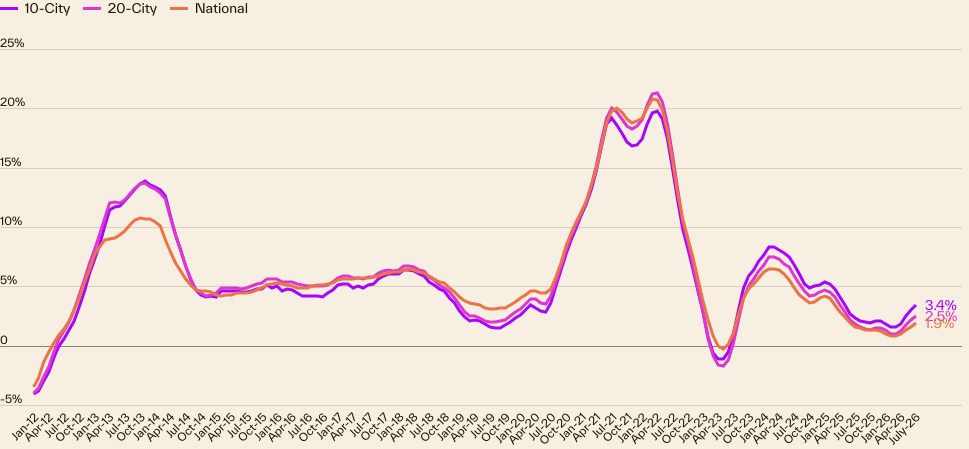
    According to the Redfin Home Price Index, U.S. home prices continue to grow, up 0.3% month over month in May. This may appear to be a slight uptick from April’s 0.2% increase, but it is the largest growth rate of 2026.

    Year-over-year, the average for housing growth sits at 2.5%, continuing the rise of the last six months.

    The largest regional increases are reported in the Midwest, with both Cleveland (2.5%) and Columbus, Ohio (1.3%) in the top five cities overall. Posting the most declines are metros in the West, with  Riverside, Calif. (-1.9%), San Jose, Calif. (-1.7%) and San Francisco (-1.3%) dropping month to month.

    “Buyers got a boost from lower mortgage rates in the spring, and that momentum is showing up in prices,” said Sheharyar Bokhari, a senior economist at Redfin. “And even though there are many more home sellers than buyers in the market, the most desirable homes are still attracting multiple offers, driving up prices.”

    Read Full Article

  • Mortgage rates average 6.52%

    Mortgage rates average 6.52%

    On June 11, 2026, Freddie Mac released the results of its Primary Mortgage Market Survey, showing the 30-year fixed-rate mortgage reached an average of 6.52%.

    “The 30-year fixed-rate mortgage averaged 6.52% this week,” said Sam Khater, Freddie Mac’s Chief Economist. “Stronger employment momentum has helped existing home sales reach a five-month high. Importantly, we’re seeing homebuyers look past the short-term rate fluctuations and actively enter the market, signaling renewed confidence in homeownership opportunities.”

    The most recent 30-year FRM reached a 6.52% average, up from last week’s 6.48%. A year ago at this time, the 30-year FRM averaged 6.84%. Meanwhile, the 15-year FRM averaged 5.84%, up from last week’s average of 5.79%. A year ago at this time, the 15-year FRM averaged 5.97%.

    Read Full Article

  • NAHB study analyzes homebuilding regulatory costs

    NAHB study analyzes homebuilding regulatory costs

    A new study from the National Association of Home Builders (NAHB) analyzed homebuilding regulatory costs, comparing results from the 2026 survey to a previous one conducted in 2021. The 2026 survey revealed that, on average, regulations imposed by the government at all levels account for $131,734, or 26.4%, of the final price of a new single-family home built for sale. Of this amount, $46,795 is due to a higher price for the finished lot, a direct result of regulations imposed during the lot’s development. The remaining $84,939 is the result of regulatory costs imposed on the builder during construction, after the builder purchases the finished lot.

    According to the study, regulatory costs are one of several factors, including record increases of tariff rates on building materials, ongoing skilled labor shortage, a decrease in available lots and tighter lending conditions, currently limiting the supply of housing, particularly housing for the entry-level market.

    Read Full Article


  • Private residential construction spending increases in April

    Private residential construction spending increases in April

    Private residential construction spending was up 0.8% in April 2026, following the monthly gain of 0.6% in March. Gains in single-family and home improvement spending largely drove this increase. Overall, total private residential construction spending was 1.7% higher than a year ago.

    According to the latest construction spending data from the U.S. Census, single-family construction spending increased 1.4% in April, consistent with the steady builder confidence reflected in the National Association of Home Builders/Wells Fargo Housing Market Index.

    Improvement spending also increased in April, rising 0.4% for the month and remaining a bright spot year over year, with spending up 7.5% from April 2025.

    Read Full Article 

  • Construction employment increases in 32 states

    Construction employment increases in 32 states

    Construction employment rose in 32 states from April 2025 to April 2026, according to an analysis of new federal data released by the Associated General Contractors of America (AGC)on May 22, 2026. Texas added the most construction jobs, adding approximately 18,700 jobs, followed by North Carolina, Ohio, Louisiana, Illinois and Missouri. Louisiana had the largest percentage gain in the span of 12 months.

    “It’s encouraging to see construction employment increasing in many parts of the country,” said Ken Simonson, the AGC’s chief economist.

    In April 2026, Florida added the most construction jobs with 6,000, followed by Texas with 3,500, Massachusetts with 3,100, North Carolina with 2,700 and New Mexico with 2,600.

    Read More

  • March sees lowest saving rates since June 2022

    March sees lowest saving rates since June 2022

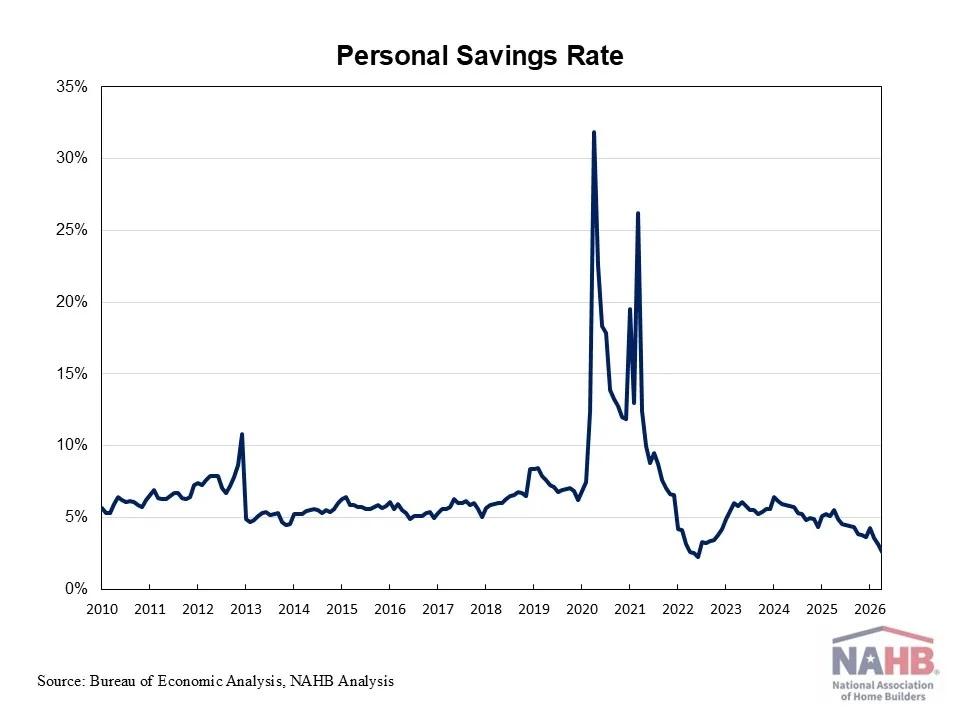
    According to the latest data from the Bureau of Economic Analysis, March 2026 saw the lowest personal saving rates since June 2022. On a year-over-year basis, personal income was 2.5% higher in March than in April 2025. As consumer spending outpaced income growth, the personal saving rate fell to 2.6%. This data point implies households are drawing more heavily on savings to support spending.

    Personal income was essentially unchanged in April 2026, following a 0.5% gain in March. Personal consumption expenditure rose 0.5% in April, following a 1% increase in March. Real spending, which was adjusted to remove inflation, increased 0.1% in April, with expenditure goods declining 0.2% and spending on services up 0.2%.

    Read More

  • Construction sees life in custom homebuilding

    Construction sees life in custom homebuilding

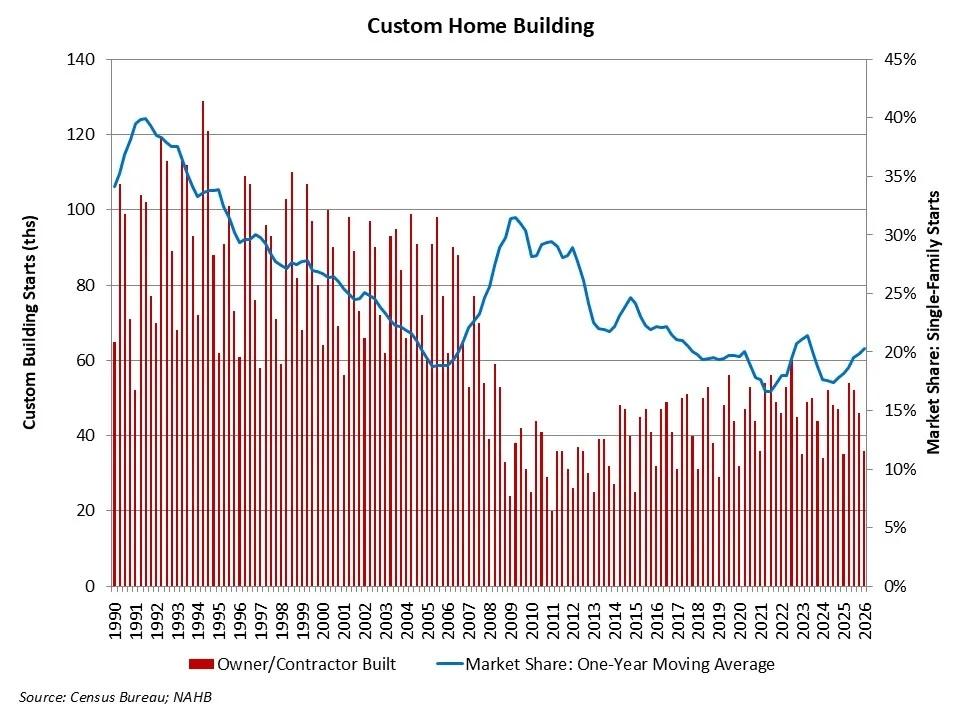
    The custom home market is not as heavily impacted by the interest rate cycle in comparison to other forms of homebuilding, making it a relative bright spot in residential construction. While overall single-family construction has been down 5% for the first four months of 2026, custom homebuilding is providing relief in the homebuilding.

    According to the National Association of Home Builders’ (NAHB) analysis of Census data from the Quarterly Starts and Completions by Purpose and Design survey, there were 36,000 total custom building starts during the first quarter of 2026. This is up 3% relative to the first quarter of 2025.

    Currently, the market share of custom builds, based on a one-year moving average, is 20% of total single-family starts.

    Read More

  • 10 cities lead new home construction

    10 cities lead new home construction

    Consumer Affairs analyzed data on new building permits and new-construction home sales across the 150 largest U.S. metros in early 2026.  The data ranked areas based on both the number of new-build permits issued and the number of new homes sold, with each factor weighted equally. Based on the analysis, 10 cities are leading the charge in new home construction, with thousands of new housing permits issued and more than 15,000 newly constructed homes sold.

    Four of the top cities in new home construction were in Texas, with Dallas holding the leading spot. The city had 11,327 new building permits issued and over 3,000 new construction homes sold.

    Houston follows closely behind in second place, followed by New York, Phoenix, Atlanta and Los Angeles, respectively. Austin, Texas, ranked No. 7, followed by Washington, D.C., Charlotte, N.C. and San Antonio.

    Read More

  • HUD releases report on best homebuilding practices

    HUD releases report on best homebuilding practices

    The Department of Housing and Urban Development (HUD) released the State and Local Best Practices for Home Construction Report, a series of regulatory actions for state and local governments to increase efficiency and ease regulatory barriers to housing construction and affordability. The report provides a clear starting point for all state and local governments to begin or continue an active effort to remove unnecessary burdens to home construction. Best practices are sorted into three categories: Cut Home Construction Costs, Unlock Land for New Housing Supply and Accelerate Construction Timelines.

    “HUD is encouraging our state and local partners to take inventory of their regulations and policies and make changes that will lower the cost to build and enable more efficient housing supply growth,” said HUD Secretary Scott Turner. “These best practices are an initial list of recommendations to facilitate growth while respecting communities’ unique needs. Adding efficiency to local building processes will result in more affordable homeownership opportunities for all Americans.”

    Read More